One of the five publications I’m editor of won the 2025 Texas Press Association Sweepstakes Award for small weekly newspapers. That’s the tippy of the tops in my line of work.
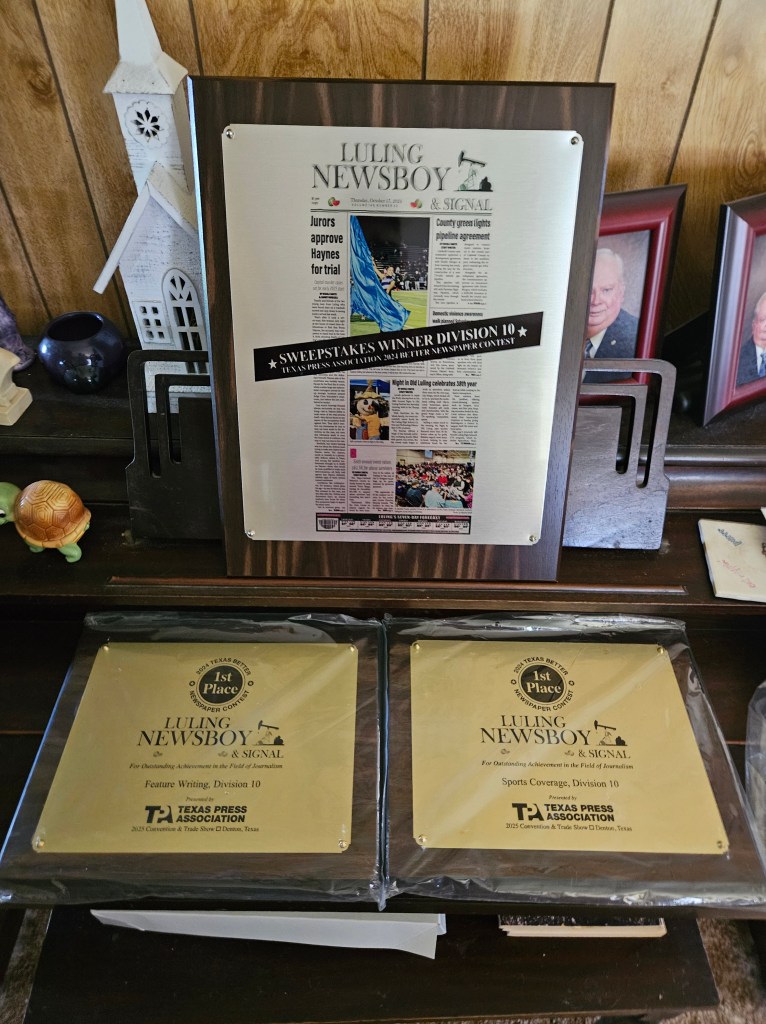
Believe it or not, it makes my career fourth so far, though this is the first one I’ve had a hand in winning this century. The other three I picked up in the 1990s.
So, those sweepstakes awards don’t exactly grow on trees, as they used to say.
The Luling Newsboy & Signal, out of Luling, Texas, is where we won, with three first place placards in individual categories (for feature writing, feature photos and sports coverage), two seconds (for advertising and news writing), and a third (for special section). They awarded points based on those six awards (from 17 possible categories), which they then add up to determine the sweepstakes winner (overall, within divisions, which are split three ways to start (dailies, semiweeklies and weeklies), then divvied up once more within those three main divisions (based on the size of a newspaper’s circulation).
I had a couple bylines in for the first in feature writing. Same is true for the second in news writing.
For the sake of giving y’all something to read, other than my lame explanation of how the contest works, I include my first-place winning feature story that appears in this year’s Winners Circle, TPA’s annual publication featuring contest winners. Just a handful of the first-place award winners from across the various categories and divisions entered in any given year are selected to appear in it. My story got picked as the one for feature writing this year.
So, what’s it about?
Here where I live, they’ve had a little race they call the Texas Water Safari each year since about the early 1960s. It’s billed as “the world’s toughest canoe race,” and having canoed random sections of the course ever since my undergraduate years (as the race actually starts in the same town as my alma mater), I must say that I truly admire those who complete the entire thing. Of those who actually won the thing, I stand in complete awe. As I believe you might as well, once you finish reading this.
But here’s the thing: This wasn’t begun by a bunch of psycho racer types.
In fact, the first two guys who did it back when were just a couple average Joes who took off one summer just to see if they could do it. Get to the coast by boat from the self-described “Gateway to the Texas Hill Country.” I mean, the map says you should be able to, if you follow it all the way down. But as I believe you’ll also read, just because it says you can, doesn’t necessarily mean that you’re going to, and if you do, it sure ain’t gonna be easy. On that, you can count…
Well, they made it. Eventually. Took them every right at a month, though even they didn’t seem quite sure of how long it actually took, days-wise. I guess once the story got retold enough times, pretty much any amount will do. Its why the finish date varies as much in their own telling of it, I suppose. As did the actual distance they traveled. Took somebody finally bothering to measure the damn thing to get in straight.
Thing is, what they walked away from it was an almost spiritual experience, one they were certain everybody else would need to experience just as they had. Well, that, and they didn’t want to be the last idiots to ever have done such a thing. But I have to hand it to them: Those rivers they travel pass through some of the most beautiful places in my state.
And some of the deadliest, as our current news cycle is chock full of at the moment.
In fact, the very same river that raged through Camp Mystic and swallowed up all those little girls who were camped in cabins along its banks is the very same river that Safari racers meet up with just outside the town of Gonzales, Texas, where the San Marcos spills into the Guadalupe and goers by that latter moniker for the rest of the way to the coast. It’s the same river that, upstream, forms Canyon Lake, and even farther upstream, passes directly through both Kerrville and Hunt, the town nearest where all those little girls were camped, all at a place that’s been hosting campers for a full century now.
My fellows in the press are demanding heads roll as they try to assess blame for the casualty count.
Way I see it, unless they point their finger straight up to the heavens, I seriously doubt they’ll ever find a more responsible party. It’s why they refer to such things as “acts of God,” after all. And there’s not a true Texan born who can honestly say they’re shocked by that fact, either. Of all the river that course to the coast here under the Lone Star, the Guadalupe is the one most peppered with blood. It’s been killing people since… well, since there were people to actually kill, most likely. It’s a wily old beast of a river, chock full of cutbacks and oddball currents, with powerful whirlpools and hidden debris that will suck you right down, pin you there and not let loose until it’s damn good ready to spit you back out again.
Twas always thus, and thus it shall remain.
And that’s when it ain’t at flood stage. Dump about a bajillion gallons of random rainfall on it, all in a single night’s time, and I wouldn’t want to be in the same zip code as that thing.
Let’s not forget, that’s the same river that practically erased half the town of Cuero back in 1998, when another flood caused one of the smaller dams to fail just a few miles below Canyon Lake. The wall of water that smacked Cuero that day was large enough and powerful enough to permanently change the course of the river in a few places before it wiped out half the town like it was built of playing cards. Most were stone or wood old enough that you think it was stone, if you trie4d to sink a nail in it. Many date back to some of the very first settlements in this state. Many ore were ship in from Indianola, after a hurricane all but wiped that town off the map. And there they stood for the better part of a century.
Til the Guadalupe got em…
Having grown up in and around Gonzales as a kid, I can’t begin to tell you how many kids that river ate whole when I was a boy. Folks just hoppin’ in for quick escape from the summer heat out at the city park, places everybody swam all summer long, until that some kid somehow manages to get caught up and dragged under by a mysterious coil of barbed wired that appeared out of thin air. Some were the absolute best athletes that town ever produced.
Til the Guadalupe got em…
And much like the story you’re about to read, on the paddling faithful who set out each summer from the headwaters at the old Aquarena Springs, back in the days when Texas State was still somewhere in the Southwest, only to make the San Marcos/Guadalupe confluence just outside Gonzales. Because even the most determined, best trained and most prepared of racers has got to be just a tiny bit discouraged when they finally make it there, some 80 miles into the race, with every last muscle in their bodies surely screaming a dictionary of cusswords at them by then, only to realize that they ain’t even half done yet. In fact, the hardest stretch is still ahead. Either way, they know they’re in it now…
The Guadalupe’s got em, for sure…
This story originally published in the Luling newspaper just days before the Safari kicked off in 2024, and passed right through the heart of that town, out past the Zedler Mill complex there at the park.
The following is the actual text used, from photo caption to the actual story. I tagged the actual pages as they appeared in our newspaper at the end, just for the visual appeal.
Hope you enjoy!
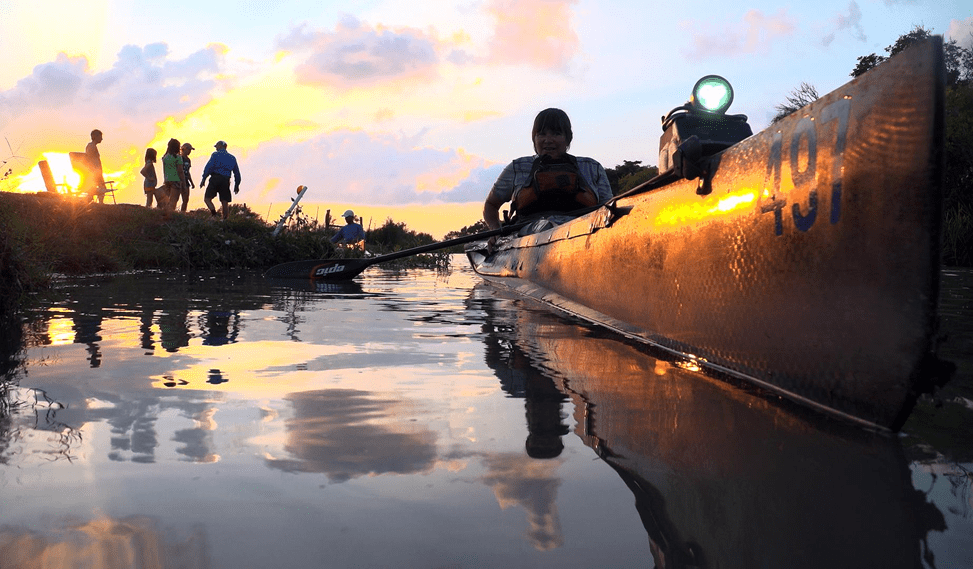
If they could only see it now…
By BOBBY HORECKA | Managing Editor | The Luling Newsboy & Signal | June 6, 2024
The year was 1962—precisely 62 years ago, in fact—when Frank Brown and Bill “Big Willie” George set out with a huge heap of supplies and a motorless John boat from the sleepy little college town of San Marcos bound for the coast, or so the story goes.
Their intended destination: Corpus Christi, some 500 miles down the sidewinding, backtracking and nearly always treacherous riverways better known as the San Marcos and Guadalupe, all just as the hottest days of the year began to set in.
Well, they made it.
Finally.
Even if it did take them right at 30 full days to pull it off. Or it might’ve been 20. Records vary, even on their own website. Whatever the actual number, one thing was certain: Those boys weren’t in it for the speed.
Still, so impressed were they on the overall experience of it all, they just knew that this was something everyone needed to try at least once.
So, the following year, in 1963, they set about organizing the first ever Texas Water Safari. Billed as “the world’s toughest canoe race,” it sent participants down the same 500 miles they traversed. Or 330 miles, they’d later discover when somebody bothered actually measuring the course.
That’s despite it feeling more like a million miles, once you made it past all the rapids, multiple portages and those awful final miles across wind-whipped bay waters, all in “the relentless soul-sapping Texas heat,” to borrow a phrase from writer Larry Rice, who penned an article for readers of the July 2009 edition of Canoe & Kayak magazine.
Any style of boat could be used. Just one rule got enforced: No motors. The only two-stroke propulsion allowed came courtesy of the good Lord Himself and the two arms He supplied you with.
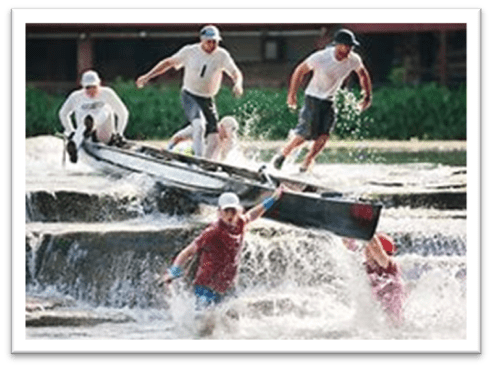
And you better like the taste of river water, because that’s all there was until you finished, besides what you managed to pack with you before the race began. No refills of food or drink were allowed. They couldn’t accept help of any sort from anyone outside their own boat, really. Anyone caught doing otherwise would be booted instantly.
Seems ol’ Frank and Big Willie had to swill plenty of that river themselves in their journey. We’re supposing they wanted to ensure everyone derived the same thrill of dysentery in the wilderness that they enjoyed.
Makes you want to rush right out, doesn’t it?
To sweeten the deal, Frank put together a rather handsome prize package, even by today’s standards. Winners could walk away a boat (this one WITH a motor), a turkey feeder, a tow-behind camper, “town lap prizes” (whatever those were) and more $6,000 in cash.
So, how many suckers — we mean, brave and daring individuals — did they manage to sign up?
Believe it or not, 126 men and one woman signed on as 58 teams that first year for what they anticipated would be a 12-day race.
It proved every bit as challenging as they said. In fact, just two of the 58 teams who started the race would even cross the finish line. When the winner was announced, it went to the team of Lynn Maughmer and Jim Jones with an official time of 110 hours 35 minutes. That’s about 4 ½ days, for those keeping track. Fred Hurd Jr. and Sam Hare, using a sailboat, took second place with a flat 145 hours on the clock (a bit more than 6 days).
Not one other boat of the 58 that started the race that year crossed the finish line. All the rest failed to qualify.
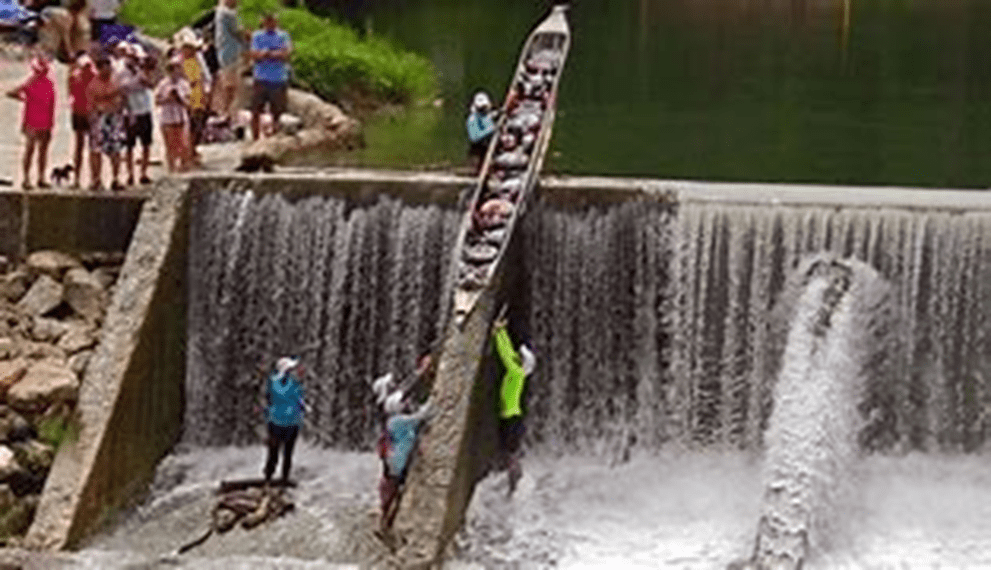
Tomorrow, as teams gather for check in at the 61st official Texas Water Safari, it will see well over 300 racers participating as 172 teams, plus scores of support personnel who are tasked with keeping tabs on their teams and supplying their paddlers with fresh foodstuffs, water and ice.
Seems the dysentery didn’t go over quite as well as they might’ve hoped.
Of course, the prize packages are long gone now, too, even the turkey feeder.
Nowadays, they do it just for the bragging rights. And not just once a year, either. Rather, they meet on the river as many as five times each year for various practice runs and mini-races, each intended to test a paddler’s metal. There’s even a race designed specifically for the kiddos each September, should one of yours make you that angry with them during the year, we’re supposing.
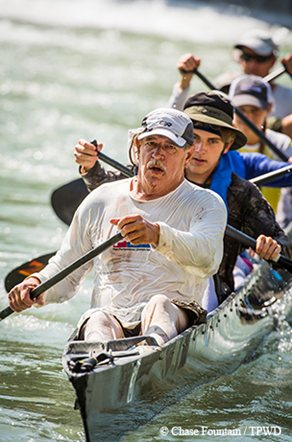
Remember that fellow named Rice who couldn’t take the Texas heat and wrote for some publication we’re almost certain nobody’s ever heard of? Never fear: The race attracts a literal who’s who of writers, photographers and publications these days. It’s been covered by everyone from the New York Times to Texas Monthly, Men’s Health Journal to Vanity Fair, The Guardian in the United Kingdom to the Examiner in San Francisco, and Der Spiegel in Germany to Telemundo out of Brazil.
Much as they always have, racers will launch Saturday morning from the headwaters of the San Marcos and make their way to the coast, though these days they now target the coastal town of Seadrift, some 260 miles downstream.
Even with the more truncated version, it’s no less challenging than it ever was. Somewhere around Mile 5 of the race, they hit the confluence of the San Marcos and Blanco rivers, not far from San Marcos proper.
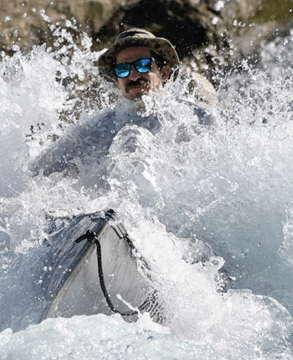
Then, it’s on to any number of portages, dams, bridges and low water crossings to the unpredictable Guadalupe, some 81 miles into the race just outside Gonzales.
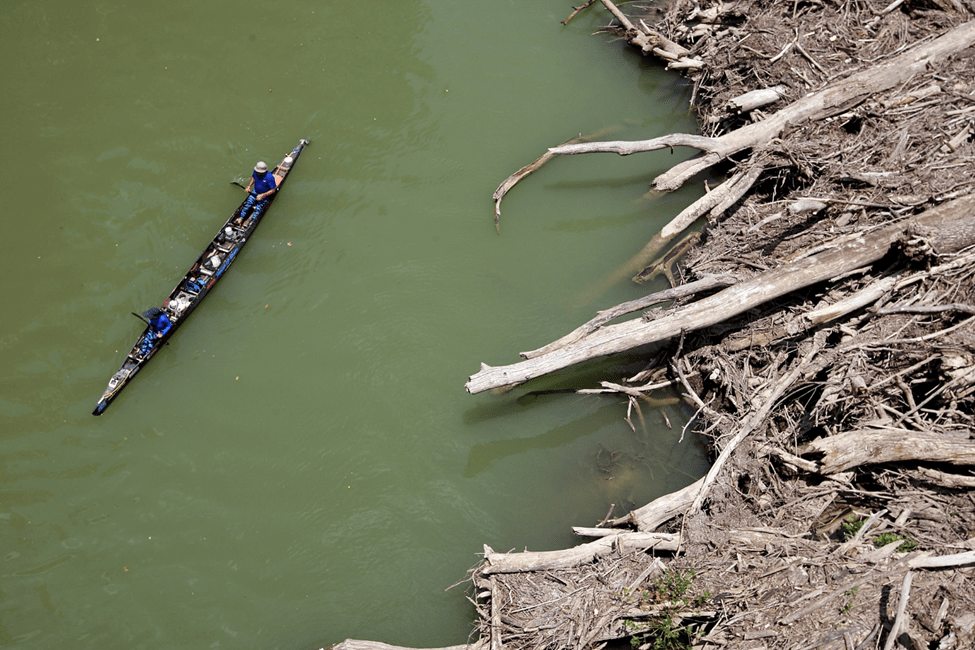
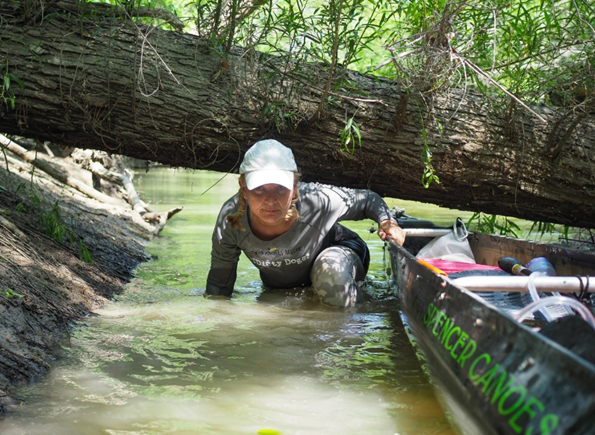
The truly disheartening part at this point has got to come with the knowledge that you’re not even half done yet, and ahead are some of the loneliest, most desolate stretches of river most have ever laid eyes on.
And what do they have to show for all these efforts?
Mosquitoes. All of them. And about a million more besides. Even if you came prepared for such an onslaught, the hum of their collective wings alone is near maddening.
If that weren’t daunting enough, there’s also a clock ticking. Each checkpoint along the course has a deadline that paddlers must keep to continue. Miss one, and it’s so long, buddy. Better luck next time. You could probably soldier on, but what’s the point, really? Sure, you may cross the finish line, but you’re disqualified just the same. In fact, they’d rather you didn’t so they don’t have to keep track of you anymore.
It is, after all, a race, even if few there even attempt to win. They strive instead, simply, to finish. Not surprising, really, when you consider the current record holder finished that race in just 29 hours and 46 minutes. That was back in 1997 and involved Bryan Mynar, Fred Mynar, John Dunn, Jerry Cochran, Steve Landick and Soloman Carriere. Absolute machines, every one of them, considering they reduced a month-long venture to just over one full day.
To cover that amount of ground — 264.7 miles, to be exact—they had to maintain a constant forward motion of roughly 9 mph for the entire 29 hours and change that it took them to cross the finish line.
Now the average man, aged 18-30 years, will take about seven and a half minutes to run a mile, four laps at the track, which is a speed of roughly 8 ½ mph. For women of the same age, that average time falls to about 8 minutes and 43 seconds, or about 6 ½ mph.
OK, when was the last time you might’ve done that run? Decades for some of us, no doubt, but remember how you huffed and puffed as you completed that final lap? Well, neither of those times is fast enough to even replicate their speed, and they did theirs for 29 hours straight, all while having to stop regularly to get past some dam/bridge/downed tree.
If you could run a 4-minute mile, you’d be moving at about 15 mph. That speed could beat them.
So long as you kept it up for 29 full hours. Nonstop. And managed to hydrate and replenish what’s bound to be a massive exertion of basic nutrients, all simultaneous.
Good luck!
Still, it can’t possibly be that hard, right?
In response, allow me to leave you in the capable hands of Roger Zimmerman, one of the original 126 men to sign on for that first Safari back in 1963. He was even crazy enough to attempt it solo.
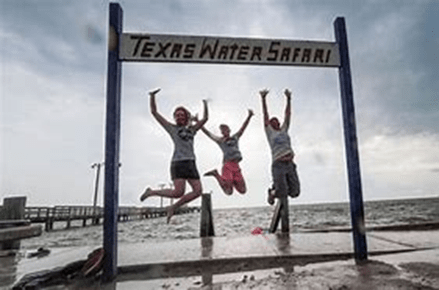
Interestingly, while keeping in touch with the group and volunteering regularly until old age prevented it, his name never again graced the lists of entrants in any of the subsequent year’s races.
Seems he had his fill that first time.
The following is his account, in his own words, written shortly before his own passing in 1999, a full 36 years after he attempted that fateful journey:
The boats started in San Marcos on April 29. There were over 50 log jams on the San Marcos River, many of them tall and massive. There was a mandatory portage “from the downstream vicinity of the Tivoli bridge into Hynes Bay” after a 3-mile log jam below the bridge. A white flag was hung below the log jam on a tree limb marking a 2.2-mile portage into Hynes Bay, increasing the portage to 5.2 miles total.
The white flag portage led across waist deep swamp water, knee deep mud and mosquitoes so thick you could hardly breathe. A number of teams quit during the swamp portage. Only 20 out of 58 teams clocked into Austwell before the official sunrise start of Leg 2 on May 8.
All the bay legs were from official sunrise to official sunset under Coast Guard supervision. The Leg 2 deadline was official sundown at Mills Wharf on May 8 where only 13 teams clocked in. May 9 proved to be the worst day of the race when 13 remaining teams left Mills Wharf at sunrise with small craft warnings flying.
Facing 30-40 knot winds with 6-8 ft waves forced nine of the 13 teams out of the race in the bay off Rockport with several Coast Guard rescues required. Only four teams remained in the race at the inland portion of the intracoastal canal leading to Ingleside. Facing 30-40 knot winds as well as strong tidal currents against us in the barge canal that afternoon, two teams including me could make no progress paddling. We were wading and pulling our boats down the barge canal when time expired.
Team 102 used oars and made it to Ingleside with moments to spare. Team 163 used a sail and were able to sail almost dead into the wind down the canal. Both teams finished the fourth leg into Corpus Christi without problems on May 10.
The 1963 Texas Water Safari was the most difficult and challenging thing I have ever attempted. And I almost finished it solo, without any food all the way from Victoria onward except for what I could find.
I still regret not making that three miles into Ingleside…
As it appeared in our publication that edition:
 Bobby Horecka, Author
You must be logged in to post a comment.